
Genesee County Tax Record Fields
No single countywide assessor roll exists for Genesee County. Every city and township assessor keeps the owner of record, parcel data, classification, State Equalized Value, taxable value, and exemptions. Each one covers only its own jurisdiction. Local treasurers then apply the tax rates and report current summer and winter bills. Once unpaid taxes enter the Michigan forfeiture process, the county treasurer becomes the office that matters.
| Field | What It Shows | Where |
|---|---|---|
| Assessed value and SEV | Michigan assessment and equalized value for the stated year | Municipal assessor |
| Taxable value | Capped tax base after ownership changes and exemptions | Municipal assessor |
| Classification and exemptions | Property class and principal-residence or other flags | Municipal assessor |
| Current tax bill | Summer or winter charge, due amount, and payment status | Municipal treasurer |
| Delinquent status | Unpaid tax route after transfer to county administration | County Treasurer or FGU |
Start with SEV. It generally sits near half of true cash value after equalization. Taxable value can be a different number entirely. Michigan caps its annual growth, and a transfer uncaps the base under state law and exemptions. A deed's sale amount is yet another figure. It may not reflect an arm's-length deal. It never automatically resets the assessor's market conclusion, so keep assessed, taxable, and sale values in separate columns when comparing years.
The official Flint Assessments Division page posts notice, value-study, and Board of Review information. It serves city parcels.
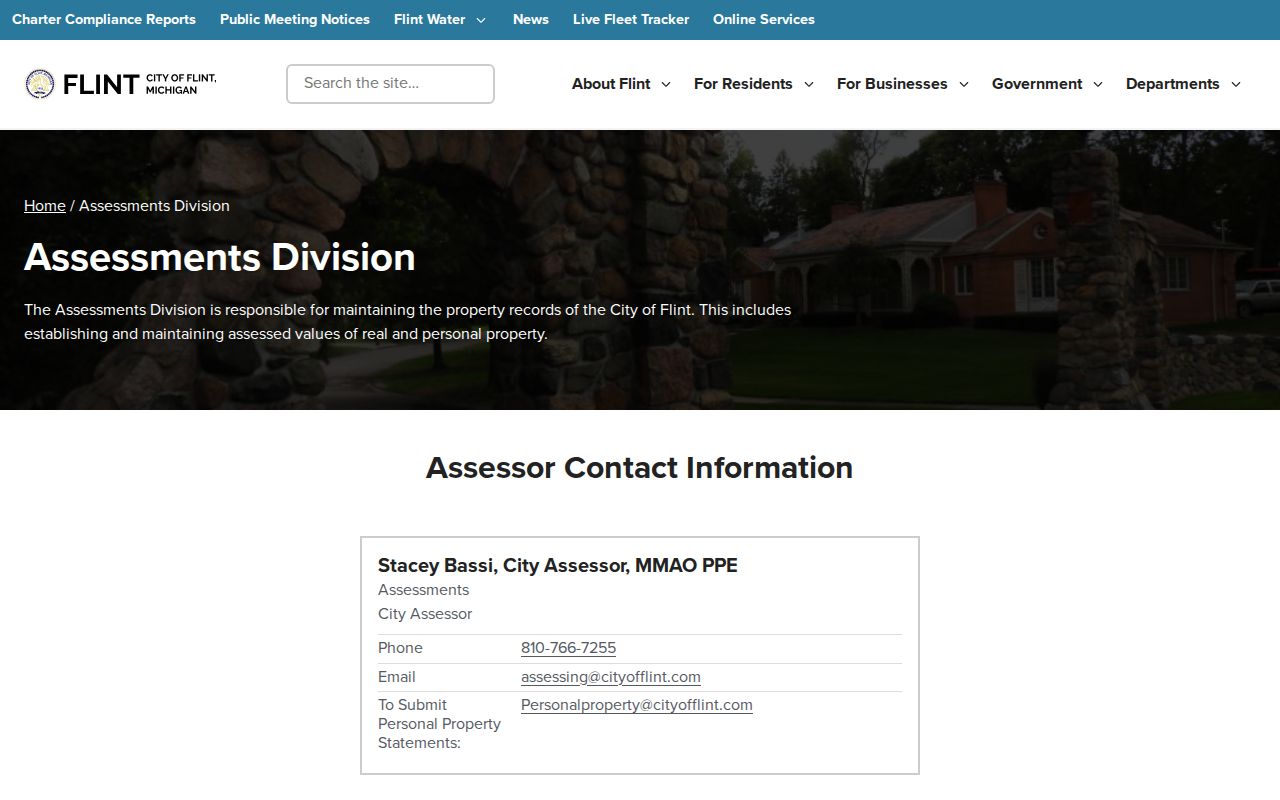
That Flint page is a city-specific example. Owners elsewhere in Genesee County should follow their own municipal assessor's schedule.
Look Up a Genesee Tax Bill
The BS&A Genesee County collection offers Detailed Record Search, Pay a Bill, Pay Delinquent Taxes, and Delinquent Tax Search. You can pay a current bill or a delinquent one. Select Flint, Burton, Fenton, or the correct township first. Then enter an address, owner name, or parcel number. The municipality choice is more than a filter. It picks the public body that maintains the assessment and the current account.
- Select the assessing municipality and search the full address or exact parcel number.
- Open the detailed record and confirm the situs, tax year, SEV, taxable value, and class.
- Read the current summer and winter bill entries and record payment status.
- Check exemption flags, then use the delinquent route if an unpaid year has left the local bill cycle.
- State Equalized Value
- The equalized assessment measure, generally about half of true cash value.
- Taxable value
- The separate capped base to which millage rates are applied.
- Millage
- A tax rate expressed in mills and applied to taxable value.
- Principal Residence Exemption
- A Michigan exemption from the local school operating tax for a qualifying principal residence.
Choose the Genesee Assessor
Owner name, situs, mailing address, parcel number, and values all come from the city or township roll. Each source feeds one field. A Flint parcel sits in Flint's assessing records. Burton and Fenton keep their own rolls, and so do the county's townships and villages. A postal city name does not always settle the assessing unit, especially near a boundary. Before trusting a search result, confirm the municipality. Use the tax notice, legal description, or county GIS map to do it.
The owner mailing address is simply where notices go. It can differ from the property address. So treat it as no proof of where a person lives. The situs, by contrast, is the physical parcel location. When two street records look alike, the legal description and APN separate them. After a sale closes, the old owner may stay on the roll until the assessor updates it. Genesee County publishes no guaranteed update lag.
Note: Match the municipality, parcel number, and tax year before comparing any Genesee County property tax figures.
Genesee SEV and Taxable Value
Michigan property tax records use several value terms, and the differences matter. Assessed value is the local assessor's valuation measure. County and state equalization then produce SEV. That figure generally lands near 50 percent of true cash value. Taxable value is the base the bill actually uses. Because growth is capped, it can sit below SEV for years. It then uncaps after a transfer under state law.
This split explains a common puzzle. Neighbors with nearly identical SEV can carry different tax bills. Their taxable-value histories and exemptions differ. It also explains why a deed's consideration is not a tax estimate. Assessor sales studies and economic condition factors feed the mass appraisal. But one recorded price does not by itself set every later appraisal.
Three values, three uses. SEV, taxable value, and recorded sale consideration are distinct fields and should never be substituted for one another.
Genesee Principal Residence Claims
The Principal Residence Exemption is known as PRE. It affects the school operating tax on a qualifying home in Michigan. Claims use Form 2368. The state sets a June 1 filing deadline each year. A Genesee County assessor record might display a PRE flag or percentage. The current form and local filing rules govern the actual claim.
Classification and exemption are different things. A parcel's class describes its assessed use. An exemption changes the tax treatment under a rule. Never assume eligibility from an old flag or a prior owner's status. For a correction or a current claim, contact the municipal assessor. Keep proof of filing. The Michigan PRE claim requirements are the statewide starting point.
Delinquent Genesee Property Tax
A current bill starts with the municipal treasurer. Delinquent real-property taxes can transfer to the Genesee County Treasurer as the foreclosing governmental unit. That office sits at 1101 Beach Street in Flint, phone 810-257-3054. Use the municipal record for ordinary current payments. Turn to the county foreclosure notice route once a delinquent year has entered forfeiture administration.
Michigan's forfeiture and foreclosure overview lays out a three-year process. Delinquency, forfeiture, foreclosure judgment, redemption, and auction are distinct stages. A portal's Pay Delinquent Taxes button replaces neither statutory notices nor redemption proof. Redemption must still be available, so confirm it first. Confirm the parcel, tax year, amount, and current stage directly with the office responsible for that stage.
- Identify the unpaid tax year and the municipality that issued the bill.
- Check whether the account remains local or has transferred to the county treasurer.
- Read the official forfeiture, foreclosure, redemption, or auction notice tied to the parcel.
- Confirm the current amount and accepted payment method with the responsible office.
Genesee Tax Access Fallbacks
When BS&A misses a parcel, turn to the Genesee County GIS map. It confirms the parcel number and municipality. Then go back to the local tax roll. Address matches fail for mundane reasons. Directionals get dropped. Suffixes differ, unit numbers vanish, readdressing and parcel splits scramble the record. Need an older Genesee County tax bill or assessment that never made it online? Call the municipal assessor or treasurer. Specify the parcel, the year, and the exact record sought.
Michigan's Freedom of Information Act, MCL 15.231 et seq., opens a written route to existing nonexempt public records. A FOIA request should be narrow. Name the year, the parcel, and whether the tax roll, notice, or payment record is the target. FOIA cannot force an office to build a fresh calculation. Does the question reach beyond the municipal portal's online years? Archives of Michigan guides list historic Genesee tax assessment series.
The Register of Deeds helps only when a recorded transfer or lien needs checking. That office does not hold tax bills. For valuation terms without the bill workflow, see the Genesee County property value resource.
Appeal a Genesee County Assessment
A Genesee County assessment dispute starts locally, not at the county Register or the deed index. The path runs through the local assessor and the Board of Review. Flint's official assessment page gives the calendar. Notices go out in February, and the March Board of Review hears protests. The same page notes a firm limit. Once the March board finishes, the assessor cannot change the assessment. Each local unit posts its own session details and filing steps. Rely on the notice for the parcel's actual municipality.
Check the record for factual errors first. Parcel dimensions and building characteristics deserve scrutiny. So do class, exemption, and the assessor's sales or economic condition factors. Bring dated photos. Add a survey or sketch where relevant. Add comparable sales and documents tied to the stated value date. Keep the assessment notice, petition, proof of delivery, and Board decision in one file. Later steps then have a clear record. After the local step, the Michigan Tax Tribunal serves as the state appeal forum. Follow the process in Michigan's taxpayer guide. Deadlines and prerequisites vary by property and appeal type, so confirm the current notice and Tribunal rules. A tax bill dispute stays with the treasurer even while a value appeal is pending.
Use the local calendar. Flint identifies February notices and a March Board of Review, while every Genesee municipality controls its own meeting details and filing instructions.