
Four Numbers Behind Genesee County Property Value
Read the assessment card and the deed trail together. Blending them into one estimate invites error. Michigan assesses property at roughly 50 percent of true cash value for assessed and SEV purposes. Taxable value can sit below SEV because it follows a statutory cap until a transfer or another adjustment applies.
| Value | What It Is | Where |
|---|---|---|
| Assessed value | Local assessor's annual valuation figure | Municipal roll |
| State Equalized Value | Assessed value after equalization | Roll and assessment notice |
| Taxable value | Amount to which millage rates apply | Assessment and tax roll |
| Sale consideration | Evidence associated with one recorded transfer | Deed and parcel card |
These figures can diverge without any error. Assessment follows an annual administrative cycle. Taxable value can be capped, and a single deed may reflect timing, condition, related parties, or terms that never resemble a typical open-market sale.
Genesee County Values Begin With the Municipality
No single county assessor roll exists. Flint, Burton, Fenton, and every township and village keep their own assessment records. A Flint mailing address may be assessed in Burton or Flint Township. A Fenton address can fall in Genesee, Livingston, or Oakland County. Verify the taxing unit first. Check the parcel card and GIS before accepting a value.
Search modes usually cover address, owner name, and parcel number. The exact APN is safer. Addresses are convenient. Directional prefixes, duplicate street names, and city-line geography can make results ambiguous. Preserve leading zeros and hyphens.
Ownership Transfers Can Uncap Taxable Value
Michigan's MCL 211.27a transfer rule anchors any Genesee County value history. Fenton's official assessor guidance is clear on the mechanics. After a transfer of ownership, the following year's taxable value is based on that year's assessed value rather than staying under the prior capped value. That jump is uncapping, not a new appraisal.
Compare transfer date, assessment year, SEV, taxable value, classification, and exemptions on separate lines. The principal residence exemption changes tax treatment. It proves neither title nor an open-market price.
Note: A transfer-year change answers a tax-administration question, not what a willing buyer would pay today.
Read Land and Improvement Values Separately
A detailed card may split land from improvements. It can also show class, structure characteristics, sketches, prior assessments, and sales. That split tells you whether a change reflects land allocation, building data, or a broad assessment update. It is not a construction-cost ledger. If the record looks wrong, gather evidence. Photographs, measurements, comparable cards, and permit or demolition documents belong in that file, and the local assessor should hear from you while its correction and Board of Review calendar stays open.
Flint Sales Studies Put One Deed in Context
The Flint Assessments Division publishes residential ECF studies, residential sales studies, and commercial or industrial study material. One nearby sale should not control a conclusion. Property class, condition, location, and study period all matter.
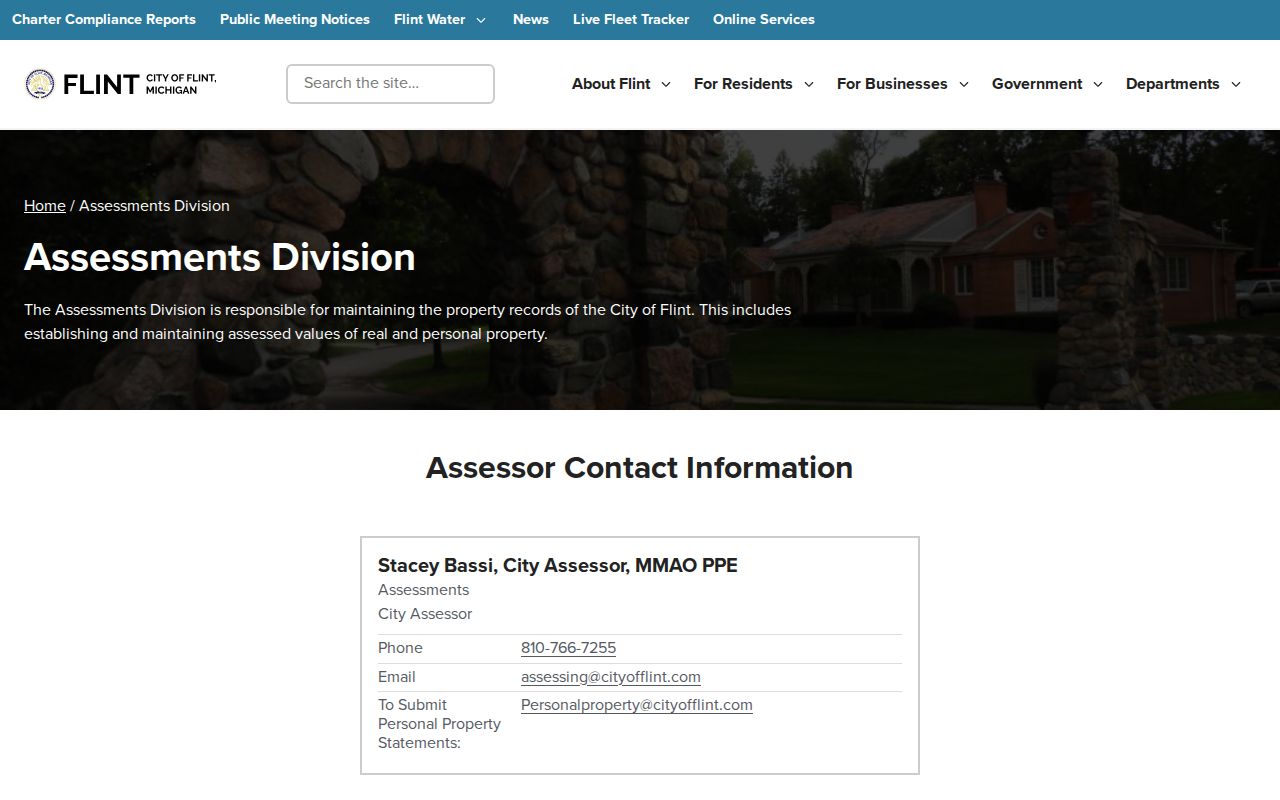
The Flint page offers more. It points to assessment notices and Board of Review information, tying the studies to the formal municipal valuation cycle.
The Notice and March Board Set the Appeal Clock
Flint's assessment notice arrives the last weekend of February. It shows assessed value, taxable value, and an estimated tax change. After the March Board closes, that value is locked. The Assessment Department then lacks authority to change the cycle's assessed value, and other municipalities set their own sessions, so confirm the correct local calendar.
Calendar matters. Preserve the notice and contact the assessing unit promptly when parcel facts or valuation appear wrong.
Look Up a Genesee County Property Value
Start at the BS&A Genesee County collection. Pick the actual taxing municipality there, and let the parcel number bridge the municipal roll, FetchGIS, and the Register of Deeds.
- Choose the correct city or township and search by situs address or exact APN.
- Record assessed value, SEV, taxable value, land, improvements, classification, exemption, and year.
- Review sale fields and confirm the transfer in the county deed index.
- Compare multiple relevant sales or a licensed appraisal for a present market opinion.
- Assessed value
- The local assessor's annual figure in Michigan's property-tax system.
- True cash value
- Michigan's market-value concept, with assessed value generally targeted near 50 percent.
- Taxable value
- The value to which millage rates apply, subject to caps, transfers, and exemptions.
Find the Recorded Transfer Behind a Sale Field
The assessor's last-sale field is a pointer. It is not the whole transaction. Search the Genesee County Register of Deeds with the displayed owner or transfer names. Then compare the details. Match recording date, instrument type, consideration evidence, and legal description. A quitclaim, family transfer, estate conveyance, or partial-interest deal makes a poor market comparison.
The Register's digitized run covers 1970 forward. Some access and images may require payment. Older evidence survives in deed books, the Register's vault, Archives of Michigan, and FamilySearch microfilm.
Read the assessor's transfer entry cautiously, because a parcel-card date may mark a sale, a recording, or a local data update depending on the field label. The deed index supplies recording date, party names, instrument type, and an image reference. The instrument itself carries the durable legal description. Preserve the labels rather than renaming a field "sale date." When consideration is absent, nominal, or affected by an exemption, do not reverse-engineer a market price from transfer tax without reliable supporting documentation.
A comparison sheet earns its keep. Put each Genesee County transaction on its own row with parcel number, property class, recording date, instrument type, stated consideration evidence, assessed value for the relevant year, SEV, and taxable value. Drop properties that differ materially in use, condition, acreage, or transfer circumstances. The sheet is not an appraisal. It simply stops one eye-catching deed figure from meeting the wrong assessment year. That discipline pays off.
Maps Supply Context, Not Genesee County Property Value
Historical aerials for Genesee County span twelve vintages, running from 1937 through 1997. They can show visible development near a parcel. Zoning and planning layers add land-use context. Behind the mapping sits reference work on section corners. A $110,393 county remonumentation grant supports it for 2026.
None of this establishes a sale price. Aerials do not reveal legal title, interior condition, or finished terms of sale. Zoning never guarantees a project, and GIS lines are not surveys. Every layer only frames the context around the value record.
County GIS publishes more than aerials. A 1924 parcel map sits alongside downloadable political and district maps. Current parcel polygons, contours, and open-data layers round out the set. Each product has a different date and purpose. A neighborhood may visibly change between vintages. Compare the assessment history for the same parcel number before drawing conclusions. A split or consolidation can create a new parcel identity. A changed mapped shape can break a simple year-to-year comparison of Genesee County property records.
Some specialized GIS products carry fees. The schedule effective August 2025 separates free public viewer access from paid parcel-data packages, custom processing, imagery, and printed maps. Those charges buy a data product, not an appraisal. An ordinary single-property value question calls for different sources. The public municipal roll and deed records are the right starting points.
Limits of a Genesee County Assessor Value
An assessor figure is not a market appraisal. It is not a guaranteed sale price, an insurance replacement estimate, a boundary determination, or a title opinion. The number reflects a stated assessment year. It also rests on the facts held by the local unit, so compare the parcel card against several relevant sales and obtain professional help appropriate to a purchase decision.
Value versus price. A Genesee County assessed value does not promise what a property will sell for. A licensed appraisal provides a separately supported opinion for a specific effective date.
Start with factual errors before debating the valuation conclusion. Confirm parcel identity first. Check square footage, classification, land area, structures, and exemptions against the parcel card. Check transfer history and situs too. Ask the municipal assessor which study area and property class apply. Keep the assessment notice and published appeal instructions. The Michigan taxpayer guide separates the local Board of Review route from later Michigan Tax Tribunal options. Deadlines and filing requirements should be confirmed for the actual tax year.
An estate or historical question may need the value on a past date. Today's roll may not answer it. Save archived notices. Save prior-year parcel cards, recorded transfers, and period sales studies. A current online card can overwrite earlier entries. The local assessor's counter or a records request may reach the year-specific material instead.
Note the effective year and source. Always label each Genesee County property value with its origin. That small habit keeps a prior assessment from being mistaken for the current tax roll. A deed transfer and a later appraisal stay distinct too.