
Genesee County Deed Types
The Register of Deeds in Genesee County accepts deeds, mortgages, liens, releases, easements, plats, and other instruments. Each one touches real estate. A deed is the one that conveys an interest in the land. Mortgages and liens work differently. They are encumbrances, claims that burden the parcel without creating a new owner. The county index sorts every document by type, party, and recording date. When the wording of a clause matters, the instrument itself controls. Pull the recorded page rather than trusting the index line alone.
| Deed Type | What It Does | Common Use |
|---|---|---|
| Warranty deed | Conveys the stated interest with warranties in its terms | Conventional sale transfers |
| Quitclaim deed | Conveys whatever interest the grantor holds | Interest transfers and title cleanup |
| Fiduciary deed | Conveys through a trustee, executor, or personal representative | Trust and estate administration |
| Sheriff or foreclosure instrument | Records a transfer arising from a legal process | Foreclosure-related chains |
| Correction deed or affidavit | Addresses an error or supplies a clarifying fact | Name or description correction |
Documents sitting near a deed can change what it means. A mortgage discharge clears that lien but names no new owner. An easement can grant a use right across a parcel without moving title. A court order, a survivorship affidavit, a land contract assignment, or a plat can appear too. Each one can alter the picture. Treat these labels as instrument families. They are not an exact list of what one dropdown holds. The official Register of Deeds page collects the record search, recording guidance, fees, and fraud-alert routes. It gathers all of it in one place.
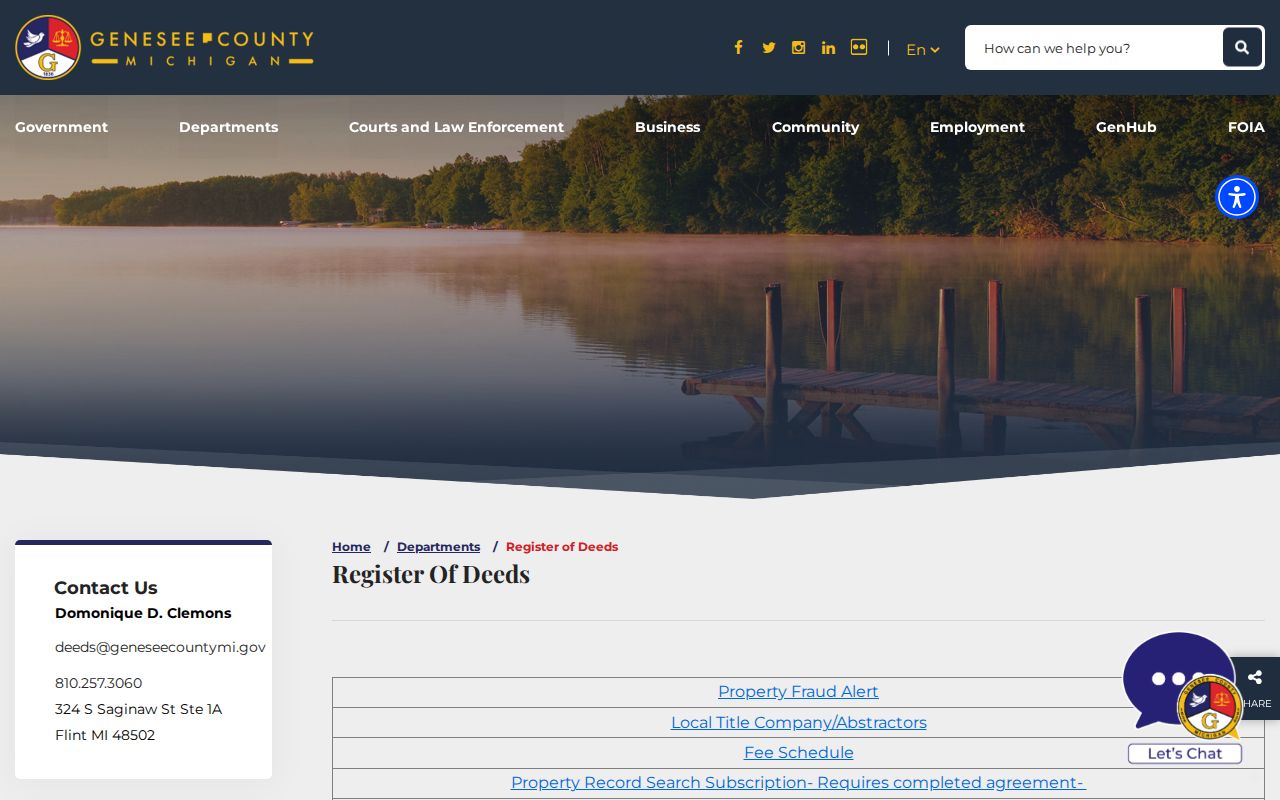
Because vendor links and counter details shift over time, the office landing page is the safest gateway. It always carries the current route into the county's own records.
Genesee Grantor-Grantee Chain
The Genesee County Register of Deeds maintains a public name index plus links to broader subscriber access. A grantor conveys the interest. A grantee receives it. Build the chain backward: get the current owner from the municipal assessor, search that name as a recent grantee in the county index, then match the deed's legal description against the assessor's parcel card before stepping further back.
- Find the current owner's acquisition deed, with that owner shown as grantee.
- Copy the grantor, date, document number, legal description, and parcel reference.
- Search that grantor as an earlier grantee and match the same land description.
- Repeat until the digital name trail ends, then move to deed books, microfilm, or archive aids.
- Grantor
- The party that conveys the recorded interest.
- Grantee
- The party that receives the recorded interest.
- Chain of title
- The linked sequence of instruments affecting ownership of the same land.
- Book/page or document number
- The recording reference used to cite and retrieve an instrument.
Genesee Deed Search Modes
The free tier is mainly a party-name index. A surname is required there. A first name, a party role, an instrument type, and recording dates can narrow the field when the live interface offers those controls. Subscriber instructions from the county describe four stronger land keys: address, legal description, parcel number, and document number. Those keys do their best work after a property search has produced the parcel number and the exact owner of record caption. So gather those details before digging into deed records.
| Search Field | Access | Best Use | Limit |
|---|---|---|---|
| Searched name | Public single-name route | Documents indexed under one party spelling | No image in the free list |
| Grantor or grantee | Portal dependent | Separate transfer roles | Exact live control needs confirmation |
| Recording date | Portal dependent | Narrow a known transfer period | Defaults and result caps are not published |
| Address or parcel | Subscriber route | Connect an assessor result to an instrument | Current parcel IDs may not appear on old deeds |
| Legal or document number | Subscriber route | Retrieve a known recording | Wording must match the recorded index |
Genesee County records roughly 80,000 to 85,000 Register documents each year, per county procurement material. At that volume, a broad name search turns noisy fast. Treat date, role, instrument type, and land description as real controls. Do not drop them. A plausible name is not enough.
Genesee Images From 1970
A county procurement record reports that Tyler Eagle went live in 2018. Documents from 1970 forward were digitized and opened to the public. One gap exists. Single-page albums were scanned but never fully indexed back to 1970. A digital page can sit in the system while a name search misses it entirely. A name search returning nothing is not proof that no deed was recorded. The county's planned integrated land and vital records project targeted July 1, 2025. That milestone reflects modernization. It does not mean every legacy book has become a searchable row. When the online trail thins, fall back on an instrument citation from a later deed. You can also use the parcel's legal description, or the Register's counter staff. Log each spelling, date range, and result as you go.
Legacy index gap. Genesee's modern digitized run begins in 1970, while scanned older album pages may still lack a complete name index.
Older Genesee Deed Books
The FamilySearch Genesee catalog lists deed records from 1836 through 1924. An index spans 1827 through 1930. All sit on 75 microfilm reels. The catalog names the originals as Register of Deeds records. Those reels, plus the office's own deed books, are the main fallback when a chain runs earlier than the digitized records. The same fallback covers an unindexed page. Historic searching follows the same logic, but it leans harder on names and land descriptions. Find a book and page in the grantee index. Read the deed. Note the grantor. Then hunt that grantor in an earlier grantee index. Transcribe township names, old subdivision captions, and lot references exactly as written. Swapping an old place label for a modern city label can hide the next match. Archives of Michigan county guides add tax rolls, probate files, and court series. Those records can explain an estate or court transfer. Yet the recorded deed remains the link in the land chain. No source shows a county fire that wiped out the chain. So trace any gap to indexing, coverage, or the record set consulted rather than to some imagined disaster.
Flint Plats in Genesee Deeds
Flint legal descriptions carry the city's plat history inside every deed. A single deed record may cite McFarlan additions, Maine's Replat, Oak Park Subdivision, or the Plat of Section 2. Each carries an older liber and page reference. A liber is simply a record book. Neighborhood labels, street names, and parcel numbers change. Those citations stay useful long afterward.
Follow the chain whenever a split, merger, or replat appears. Track the lot, block, plat, and parent parcel. Also follow any affidavit of division or correction along the way. The county GIS map can orient you to the current polygon. It is not a survey. The recorded plat, the deed description, and a professional survey each answer a different question. When a deed cites a prior liber and page, treat it as a bridge back to the earlier instrument. This holds even if no modern parcel number appears.
Note: A historic neighborhood name adds context, but only the instrument's legal description identifies the land a deed conveys.
Genesee Recording Fraud Alerts
The Register's page links a Property Fraud Alert service. It notifies a subscriber when a document is recorded under a chosen name. It is only an alert. It does not block recording, guarantee title, or replace checking the index yourself. Before signing up, confirm the current enrollment options, delivery methods, and terms. Those details can change.
If unexpected mail arrives, check it through the county's published contact. Someone demanding urgent payment deserves the same caution. Compare the notice against the index. Dial the Register independently. Save the document number. Never trust a phone number that appears only inside a threatening message. A recorded deed can be public and still invalid. Resolving a disputed instrument may call for legal advice.
Obtain a Genesee County Deed
The free public search returns a list of documents indexed under a name. It does not return the deed image itself. A single-name search costs $8.75, and images run $1 per page. Confirm the current fee schedule before sending payment. Subscriber search opens more routes, including address, legal description, parcel number, and document number. Save the recording reference before you leave an index result.
For office help, call 810-257-3060. Official pages have listed two different Flint locations, 324 S. Saginaw Street, Suite 1A, and 1101 Beach Street, Room 138. Call ahead and use the current county page for the day's counter address. Ask staff whether your use needs a plain image or a certified copy. Ask what mailing information is required. Give the exact indexed party name whenever you have it. Include the recording date, document number, and book or page citation too.
Recorded, not guaranteed. Genesee County deed records show what was accepted and indexed, but recording alone does not make an instrument legally valid or disclose every unrecorded interest.