
Trace Former Genesee County Property Owners
No ready-made owner history is attached to a Genesee County street address. Former owners emerge only by rebuilding the chain of recorded transfers in reverse. Take the most recent deed and note its grantor. Then locate the deed by which that same grantor bought the land. Repeating that loop moves steadily backward through the parcel's ownership. The legal description is the glue holding the chain together. Addresses, parcel numbers, or municipal labels may shift along the way.
| Source | Years It Covers | Where Held | What It Shows |
|---|---|---|---|
| Tyler Eagle modern run | 1970 forward, as described in county procurement | Register of Deeds online search and office | Indexed instruments and recording references |
| Deed books | 1836 through 1924 in the FamilySearch catalog | Register originals and microfilm | Earlier deeds and legal descriptions |
| Grantor-grantee index | 1827 through 1930 in the catalog | FamilySearch microfilm and Register | Name route into older deed books |
| Historic tax series | From 1844 in the Archives guide | Archives of Michigan | Dated assessed-owner or taxpayer clues |
Start any modern transfer search online. Once the trail reaches back past 1970, or a name search stalls, shift to the Register's original volumes, the 75-reel FamilySearch catalog run, and archive finding aids. Tax rolls and city directories add useful context. They never substitute for the deed chain itself.
Begin the Genesee County Chain With the Current Grantee
Start with the assessor. Ask the municipal office for the current owner of record and the parcel number. That pairing anchors everything that follows. Take those details to the Register of Deeds and search for the present owner as grantee. From the deed that comes back, note the recording date, instrument type, document number or book and page, both parties, and the legal description. That deed is your anchor. It names the most recent of the former owners. You are about to build that chain.
Access works in two tiers. The free public mode runs as a name index only, without document images. A paid subscription unlocks searching by address, legal description, parcel, and document number. Images cost $1 per page, and a single-name search runs $8.75. You should confirm current fees with the county before ordering anything. The official Register page also lists the county's online search options and instructions.
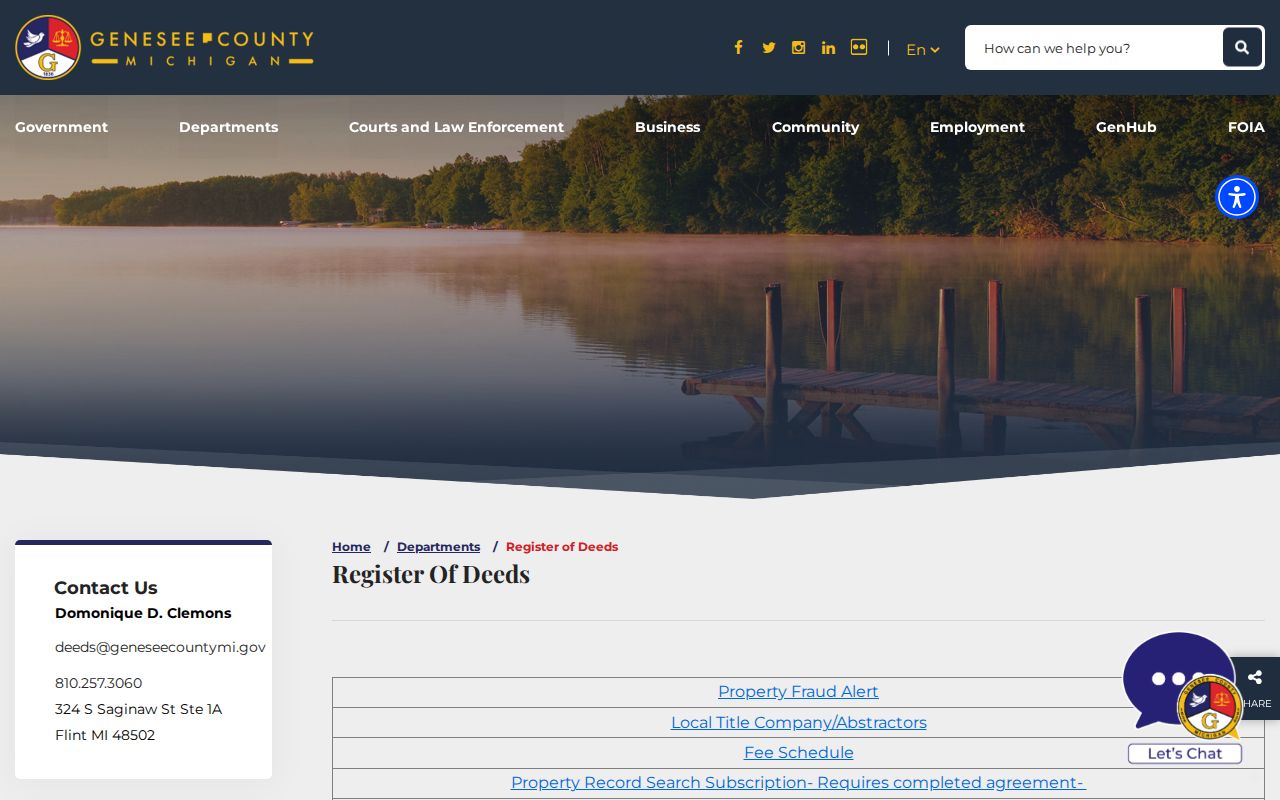
When an online index result looks incomplete, or an old volume must be consulted directly, the office itself is the fallback. Always tie each prior owner to the exact parcel description. A shared surname alone proves nothing.
Walk the Genesee County Deed Chain Backward
Every deed supplies the name needed for the next search. Log each transfer in its own row. That discipline keeps similar surnames, trusts, and entities from blurring into one another as the chain grows.
| Transfer date | Grantor to grantee | Deed type | Book/page or document |
|---|---|---|---|
| Newest recorded date | Prior owner to current grantee | As indexed | Copy exact reference |
| Earlier date | Earlier owner to prior grantee | As indexed | Copy exact reference |
| Paper-era date | Name found in reverse index | Read from deed book | Preserve liber/page |
- Find the current owner's acquisition deed with that owner as grantee.
- Read the grantor and verify the parcel through its legal description.
- Search that grantor as an earlier grantee and repeat the comparison.
- At the online cutoff, continue through the reverse index and deed books.
- Grantor and grantee
- The transferring and receiving parties named in an instrument.
- Chain of title
- The ordered sequence of instruments affecting ownership.
- Reverse index
- The grantee-side name index used to find how a former owner acquired land.
- Warranty versus quitclaim
- Different deed forms with different covenants; neither label alone proves a complete chain.
Search Beyond Genesee County's Single-Page Album Gap
County procurement material from 2024 reports that documents from 1970 forward were digitized. They were also made publicly accessible. The same material says an older single-page album was scanned. But it was never fully indexed back to 1970. A page can sit in the system unindexed. A name search will simply miss it.
Work around the gap with spelling variants and shorter date ranges. You can also use document or book/page references lifted from later deeds. Then ask the Register to check the album or its associated index directly. The modernization targeted for July 1, 2025 is no guarantee. Not every legacy page became searchable.
Note: An empty online name result is not proof that no earlier Genesee County instrument exists.
Continue Former Genesee County Owners on Microfilm
The FamilySearch catalog lists deed records from 1836 through 1924 plus a name index spanning 1827 through 1930, all on 75 reels, with originals held at the Register. Use the grantee index to spot a former owner's acquisition. Then pull the cited volume and page. The catalog page documents that microfilm fallback for deed records the online system cannot reach.
Those coverage dates mark an honest limit on what the microfilm collection can prove about earlier owners.
Follow Genesee County Legal Descriptions Across APN Changes
Splits, combinations, and replats can retire a modern parcel number mid-chain. Follow the parent parcel instead. Track the acreage, plat name, lot and block, metes-and-bounds calls, and any affidavit of division or correction. Historic Flint searches may surface McFarlan additions, Maine's Replat, or Oak Park Subdivision. Each carries liber/page clues worth recording.
A plat name often outlasts a street address. Compare the recorded plat against the current GIS map. But let the deed and survey evidence govern any legal conclusion about the parcel.
Bridge Probate and Fiduciary Transfers in Genesee County
A tidy person-to-person chain can snap when an estate, trustee, personal representative, or court order carries the interest. Search the exact capacity the deed states. A survivorship affidavit, fiduciary deed, or certified probate order can explain the transfer even when the beneficiary never appears in the immediately prior deed.
MiCOURT is an informational index with restricted categories and spotty older coverage. Confirm any public probate file with the court clerk. Then return to the Register for the recorded instrument affecting the real estate.
Add Genesee County House History Without Changing the Chain
The Flint Public Library Local History and Genealogy Room holds city directories, newspapers, yearbooks, local publications, and city histories. Microfilm readers and scanners are available. Staff-assisted obituary research costs $25 for about one hour, payable even when no answer surfaces.
A directory listing or obituary can show who lived at an address. Neither one proves ownership. Note the year, publication, and page of every clue. Then test it against a deed or a dated tax roll before adding it to the chain.
Know How Far Back Genesee County Former Owners Go
Genesee County was created in 1835 and organized in 1837. The deed-book run reaches back to 1836, and the related name index to 1827. No evidence points to a single courthouse fire or flood. Nothing wiped out the land record chain. The real obstacle is uneven indexing across paper, microfilm, and scanned deed records.
Online coverage stops before the record does. The modern Genesee County digitized run is described from 1970 forward. Use microfilm, deed books, archives and the Register vault for earlier former owners, and never use the trail to harass a living person.
Once the backward chain gives you a citation for a particular instrument, stop there. The Genesee County deed records guide shows how to obtain that document. Deed records are only part of the story. The Archives of Michigan guide also lists older tax, probate, business, naturalization and voter series. These add context around a deed-book entry. Cite each one by record group and year. A tax roll can reveal the assessed owner or taxpayer at a given moment. A probate file may name a fiduciary or a court-authorized transfer. Neither should quietly stand in for the recorded conveyance itself.
Addresses shift over time, too. A directory might list a neighborhood or road name. It can differ from the modern GIS label. Write down the old wording exactly. Then compare a dated plat, a newspaper notice and the current parcel. The historic source may say township while the current record says city. Keep both jurisdictions with their dates rather than correcting the old entry.
Finish with a chronology that cites every step. Give execution and recording dates when both appear. List the parties in their stated roles. Include the deed type, the instrument or book and page, and the legal description used to match the land. Mark any gaps openly. A documented break beats an invented former owner. It points the next researcher to the index, reel or office volume that still needs inspection.